U.S. GOVERNMENT & POLITICS, SPRING 2011
CONGRESS, DAY TWO: THE LAWMAKING PROCESS
Woll 58 (Fiorina), 59 (Dodd), 61 (Fenno on why we love our members of Congress), 63 (Fenno on home style and members’ career paths)
Wednesday, March 2
In various and related ways, today’s Woll readings highlight the nature of lawmaking in Congress. Today’s class’s central point is that lawmaking today does not function as the neat and orderly process described by the famous “How a Bill Becomes a Law” chart (see OSY p. 182 and the flip side of this page for versions of this chart). We will review the messy characteristics of the process today, seeing how they relate to members’ roles and patterns of behavior.
Fiorina (Woll 58) argues that the growth of a large, active federal bureaucracy serves the purposes of members of Congress – they get credit for program creation and for solving constituent problems that arise. This theory is entirely consistent with Mayhew’s assertion that members of Congress are single-minded seekers of re-election
Dodd (Woll 59) explains the committee and subcommittee system as a means of giving every member of Congress what s/he wants: some position from which to exercise power
Fenno (Woll 61) gives greater consideration to committees and how they help individual members to shape their careers and to gain re-election. He highlights the reasons why the public can dislike Congress as an institution but love the individual members
Fenno appears again in Woll 63 to discuss home style – the ways in which members relate to their constituents. Fenno points out that home style evolves over time, and as members gain more power in Congress they face dilemmas about how to present this power and their choices to their constituents.
How a Bill Becomes Law (textbook version)

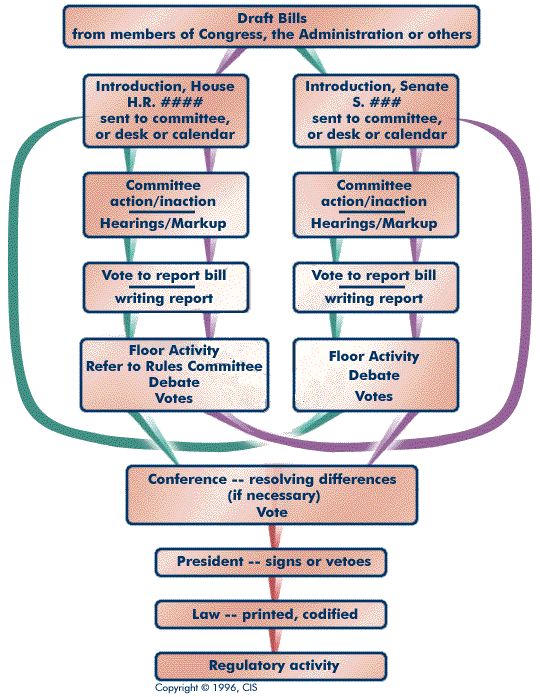
Source: Lexis-Nexis Congressional Universe, URL:
http://web.lexis-nexis.com/congcomp/form/cong/h_law.html?_m=48bf77a4c5b7a2bcb4bf36d348aa3b54&wchp=dGLbVtz-zSkSA&_md5=11b90e1a6333544b397469132966b0ef
How a Bill Becomes a Law – Reality Version
MOTIVATING FACTORS BEHIND LEGISLATION
Party leadership leaders in House (Speaker, majority leader, minority leader, whips) or Senate (majority and minority leaders, whips) wish to fulfill their agenda through passing legislation, and/or to score political points vs. other party in eyes of media, public; more important in House than in Senate
Individual members members are “single minded seekers of reelection” (Mayhew), passing legislation is one way to demonstrate effectiveness to constituents (credit claiming); members may also support each other’s bills, deliberately exchanging support (log rolling)
Committees committees exist to develop expertise within each chamber on specific issues, can use this expertise to push a particular policy
President as leader of his party, the President has his own agenda and seeks to fulfill it through congressional action
Issue networks includes any entity that is concerned about a particular policy area:
- House committee(s) – one or more committees responsible for specific policy area, Budget and Appropriations committees also involved (jurisdiction is often overlapping, see multiple referrals)
- Senate committee(s) – the Senate and House are fiercely independent of each other; in recent years Senate has been more politically moderate (esp. Republicans) than House
- President – not always a player on every issue, but commands media attention if interested
- Office of Management and Budget – Executive branch agency within the White House, writes president’s budget, monitors agency/department spending, pushes president’s agenda on all fronts
- Executive branch departments/agencies, independent agencies and commissions – these groups carry out policy and have a vested interest in how it is made; politically tied to president but also largely independent of president’s direct control
- Interest groups – organizations, corporations, institutions, ANY GROUP that cares about the policy area in question
- the news media – can highlight a specific issue, bring/force it into public eye and drive presidential and congressional attention
- the public – usually involved through interest groups but can also directly contact legislators on issues of concern
Recognizing who the issue network
participants are will help to analyze and explain congressional action (or
inaction) on any area of interest!
HOUSE TACTICS TO STALL/KILL BILLS
- Committee/subcommittee level – never report any bill to floor
- Budget, Appropriations committees – can decline to fund a specific program, can constrain spending in an area and thus prevent new legislation
- PAYGO budget rule (now suspended, may be back soon) – cannot create a new program or spend new money without offsetting cuts to existing programs, or new revenue sources to pay for new program
- Multiple referral – more than one committee given jurisdiction, more than one bill created (usually slows down process considerably)
- Post-committee adjustment – bills passed in committee can be changed by party leadership before going to Rules Committee/floor
- Rules Committee actions – decline to create a rule; create rule that disadvantages one version of bill (e.g. king of the hill, queen of the hill rules)
SENATE TACTICS TO STALL/KILL BILLS
- unanimous consent agreement (UCA) - necessary to bring bills to floor, requires majority and minority leaders to agree (and often they don’t); any senator can object (unanimous means unanimous!); majority leader in particular can simply not bring a bill up for consideration
- hold - individual senators can prevent consideration of any bill (anonymous tactic)
- filibuster – a senator can hold the floor for unlimited time to stop a bill; 60 votes required to end a filibuster (cloture), hard to get 60 votes in closely divided Senate (the current Senate is 53 Democrats/affiliated, 47 Republicans)
- non-germaneness rule – senators can amend any non-budget bill, amendment doesn’t have to relate to bill (in the House, all amendments must be germane)
CONFERENCE COMMITTEE TACTICS TO STALL/KILL BILLS
The final version of a bill (called a report) is produced in a conference committee, and cannot be amended in either chamber (members vote yes or no on a conference committee report)
- House and Senate leadership can fail to appoint conferees (bill dies due to no action)
- conferees can be appointed to amend the bill so it is unacceptable to one chamber (deliberate sabotage)
- conferees can fail to agree on anything (no report produced)
- conferees can agree and issue report, but one chamber refuses to schedule a vote (Speaker has this power in House, majority leader in Senate or lack of UCA in Senate)
PRESIDENT’S TACTICS TO STALL/KILL BILLS
- veto, threat of veto can keep Congress from acting, kill what Congress passes
- pocket veto – can let a bill die without vetoing within 10 days of Congress adjourning
TACTICS TO ADVANCE/PASS BILLS
- committee/subcommittee chair can use party leaders’ support (and any other factor listed below) to move legislation along
- members can work with other members (reciprocity) within or across committees and subcommittees to accomplish each others’ goals
- outside pressure (interest groups, media, public, impending election) can motivate action
- committee/subcommittee hearings can call attention to an issue/bill
- national crisis (post September 11) or other significant events (Columbine shootings) can necessitate and/or motivate action
- president can use the “bully pulpit” (power and visibility of the office) to call for action – State of the Union address, public appearances, press conferences and other media opportunities (no individual member of Congress has this national level of visibility)
- discharge petition (House only) – a bill can bypass all committees and be brought directly to the floor if a majority (218 members) sign a petition to do so; the threat of discharge petition often gets things moving (only two bills brought to floor via discharge petition have passed in the last 100 years)
- national reform mood – at some points in American history, it’s easier to get things done because many things are being accomplished (Progressive era, New Deal, “Great Society” programs of 1960s)
- good ideas sometimes create their own momentum
POLICY WINDOWS
As may or may not be clear from the preceding material, it is easier to stop legislation than to pass it. Some legislation MUST pass on a regular basis (the 13 components of the federal budget, for example). But other legislation depends on the right conditions to have a chance. These conditions are collectively described as the policy window. Modern scholars of the congressional process believe that policy windows are not “open” for very long on most issues, thus knowledge of congressional rules and a good understanding of external actors (those outside Congress who care, aka the issue network) are necessary in order to accomplish something while the policy window is open.