Required texts/materials
-
About Teaching Mathematics: A K-8 Resource, Fourth Edition, by Marilyn Burns
-
Math Facing an American Phobia by Marilyn Burns
-
Math Course Packet
- 1 inch binder for math methods courses.
-
One packets binder dividers or Post-it note type tabs.
-
Packet of sticky notes
- Funds in your GAC print account to print documents from Moodle site
There are other readings provided by the instructor on either Moodle, the class schedule or the Internet.
Access to Education:
Every student has a right to learn and to participate in this class. I recognize that we all learn differently. If you have learning challenges, please see me about how we can work together to support your learning needs. Bring any documentation and suggestions about how I may assist you. We will work together to make this a great learning experience for you.
Disability Services
At its May 2011 Faculty Meeting, the faculty approved changes to Faculty Handbook Section 2.2.7: “Through information provided in syllabi, faculty members will notify students of the availability of disability services at Gustavus and how to access them.” The following statement is recommended for inclusion on all syllabi:
Gustavus Adolphus College is committed to ensuring the full participation of all students in its programs. If you have a documented disability, or you think you may have a disability of any nature (e.g., mental health, attentional, learning, chronic health, sensory, or physical) and, as a result, need reasonable academic accommodation to participate in class, take tests or benefit from the College’s services, then you should speak with the Disability Services staff, for a confidential discussion of your needs and appropriate plans. Course requirements cannot be waived, but reasonable accommodations may be provided based on disability documentation and course outcomes. Accommodations cannot be made retroactively; therefore, to maximize your academic success at Gustavus, please contact Disability Services as early as possible. Disability Services (https://gustavus.edu/advising/disability/) is located in the Academic Support Center. Disability Services Coordinator, Kelly Karstad, (kkarstad@gustavus.edu or x7138), can provide further information.
Help for Multilingual Students
Support for English learners and multilingual students is available through the Academic Support Center’s Multilingual Learner Tutor (https://gustavus.edu/advising/). The MLL tutor can meet individually with students for tutoring in writing, consulting about academic tasks, and helping students connect with the College’s support systems. When requested, the MLL tutor can consult with faculty regarding effective classroom strategies for English learners and multilingual students. If requested, the MLL tutor can provide students with a letter to a professor that explains and supports appropriate academic arrangements (e.g., additional time on tests, additional revisions for papers). Professors make decisions based on those recommendations at their own discretion. In addition, English learners and multilingual students can seek help from peer tutors in the Writing Center (https://gustavus.edu/writing center/).
Questions about these policies can be directed to Dean Julie Bartley (jbartley@gustavus.edu or x7541) or Dean Micah Maatman (mmaatman@gustavus.edu or x7541).
Title IX
Title IX is federal legislation that makes clear that violence and harassment based on sex or gender are civil rights violations. Gustavus Adolphus College takes incidents of sexual misconduct seriously. Sexual misconduct includes the following: Non-Consensual Sexual Contact, Non-Consensual Sexual Intercourse, Sexual Exploitation (taking non-consensual or abusive sexual advantage of another), Intimate Partner Violence—physical, sexual, or psychological harm by a current or former partner or spouse, Stalking.
Please see the student sexual Misconduct Policy in the Gustavus Guide for more details and definitions or online at: https://gustavus.edu/dean of students/policies/gustative/sexual-assault.php
Not all college employees are mandatory reporters. However, all faculty are legally mandatory reporters and must make a formal report to the Dean of Students Office within twenty-four hours. If you have any questions, contact the Title IX Coordinator (Julie Kline, Director of Human Resources, at 507-933-6075) or one of the deputy coordinators (https://gustavus.edu/titleix/titleix.php).
Academic Honesty and Policy
At its November 2006 Faculty Meeting, the faculty approved changes to Faculty Handbook Section 2.2.9: “Through information provided in syllabi and/or other means, faculty members will explain to students how the Honor Code will operate in their respective courses.” The following statement is suggested as a pledge for students to sign on all graded assignments and projects:
“On my honor, I pledge that I have not given, received, or tolerated others’ use of unauthorized aid in completing this work.”
A similar statement may be signed by students at the beginning of a course, indicating that their work for that course will comply with the academic honesty policy and the Honor Code.
Full descriptions of the Academic Honesty Policy and the Honor Code can be found in the Academic Catalog (online at https://gustavus.edu/general_catalog/current/acainfo). For more information about the Honor Code, contact Dean Julie Bartley (jbartley@gustavus.edu or x7541).
This course will abide by the Gustavus Adolphus Honor Code. Ethical behavior is a must for teachers. Plagiarism will not be tolerated.
Department of Education Conceptual Framework
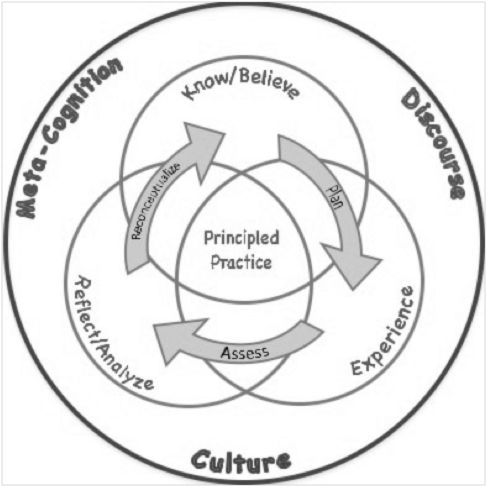
All components of the Education Department's Conceptual Framework are embedded within the Capstone Study of Teaching project that students complete for EDU 371/373. Students use their knowledge of best practice teaching strategies to plan lessons for their practicum classroom. They teach these lessons to K-6 students while in practice (experience). They video tape their teaching episodes. They analysis their teaching in the episodes using qualitative research methods where they uncover practices in their teaching that were not explicit while they are teaching. This study “awaken teachers to see beyond their habituated perceptions, and in so doing become more mindful of individual children, classroom dynamics and their teaching practices.” (Kesson, K., Traugh, C. & Perez, F. 2006) and to see what is happening “cognitive emotional and social levels” as you work toward improving practice (reconceptualization).This work of a principled practitioner takes place in a context where candidates are thinking about their thinking as it relates to their work with students (metacognition), as well as fostering their students’ higher level thinking; exploring cultural connections and influences on their learners (culture) and considering the ways in which we communicate about the knowledge that is being learned (discourse).
The co-constructed (teacher candidates and instructor) goals
for the math methods are:
Gustavus Education Attendance Policy
1) Cumulative absences (excused or not excused) equaling 15% or more of scheduled class meetings will result in a lowering of the grade by one letter grade. Cumulative absences (excused or not excused) equaling 25% or more of scheduled class meetings will result in a D grade. This will require a retake to remain in the education program. Excused absences are those that come with written documentation. Illness excuses must be communicated to the instructor at least one half hour prior to the start of the class period. Extenuating circumstances may be considered by the instructor.
2) Five or more late entrances into class (for one hour classes) and two or more late entrances (for longer classes) will result in a decrease of the final grade by one letter grade.
3) Absences from any practicum requirement for this course without prior contact (at least a half hour prior to the start of the placement experience) with the instructor and the placement teacher will result in a decrease in the final grade by one letter grade. All visits will be verified with the practicum teacher or site coordinator. In addition, more than one excused absence must be made up by the student on the student’s own time, with a signed statement form the placement teacher/site manager attesting to the additional visit(s), returned to the course instructor before the end of the semester.
Assigned Readings
Assigned readings are a vital aspect of the course. Your readings in the course textbooks, course packet, research articles and handouts have been carefully selected to provide you with the depth and breadth that you will need as you teach mathematics in the elementary school.
To facilitate your reading, each week, a reading assignment, based on guided reading principles, will be distributed at two-three week intervals.
It is expected that you will review these readings after class and as you prepare assignments and projects for this class. Some will provide background information for what we do in class, others will elaborate afterwards, and a few provide insights about things we do not have time to adequately explore in class. The readings for this course are the frame for the "knowledge" portion of the Department of Education's Conceptual Framework and represent the theory behind "best" practices. Assigned readings will be important for your participation in our classroom conversations.
Email:
I will be using electronic mail to send you assignments, feedback, and other important documents, thus my expectation is that you check your Gustavus e-mail daily. Knowledge and application of sending, receiving, and attaching documents to e-mail is assumed for all students in this course.
Evaluation and Assignments
The emphasis in this course is on learning, understanding, and application of pedagogical knowledge in relation to the teaching and learning of math at the elementary school level. Expectations are high for all students in terms of the quality, integrity and consistency in completion of all assignments. It is also assumed that learning in this course occurs from a continuing process of discourse (whether it be written or verbal). Expectations are equally high for all students in terms of active, purposeful, and thoughtful participation in both whole and small group context with continued efforts to support the cooperative learning of all.
Note about electronic grading:
The majority of your assignments will be turned in electronically through e-mail. It is your responsibility to keep complete copies of all electronic assignments until your final grade is posted at the end of the semester.
Professionalism (Dispositions): (15%)
What might this look like?
- You are punctual and ready for class each and every day: supplies and books ready to go and out; food and snacks are put away; cell phone is on silent and stowed away; hats removed.
- You exhibit a high level of professionalism and integrity in your thoughtful preparation and attendance for all classes. This includes consistent evidence that you have thoughtfully completed assigned readings for each session.
- Gracious and thoughtful participation in class discussions on a regular or consistent basis. This means that you are not only participatory, but, you listen to others as well. Your "air time" is proportional to the other students in this class. Your participation includes consistent small group and whole class contributions.
- You appear interested and engaged in the math methods course content. This means that you are not doing assignments for this class nor other classes, attending to e-mail or text messaging during class, and are "present" in the class session. Class conversations center on the content of the math course.
- It is clear that you regularly read and respond to to email from the instructor.
- Demonstration of personal and professional behaviors and affect as designated on the Department of Education's Statement of Professionalism.
Developing as a principled, inclusive, cooperative, and environmentally sustainable practitioner of math: Expectations are high that completion of each and every one of the pieces below will be completed with high integrity. See each individual assignment description for more details. (65 points)
Science and Math autobiography to Michele: 5 points(Due: via e-mail by Tuesday, February 27)
Math Notebook (15 Points): First check, March 20; Second check: May 17.
Mini-math lessons (2): 10 points
Math calendar: 5 points
Practicum Math Lesson Plan 1, 2 and or 3 (due 2 full school days before you teach it in your classroom). (25 points for all lessons)
Completion of BOT SEP 7: 5 points
Developing a
purposeful, systematic inquiry into practice through the Study of Teaching due on Friday, May 25, 2018 (20 points)
Each
one of us is building an understanding of teaching as a journey of
learning and process. The purpose of this assignment is develop “mindful
educational practice to gain depth and purpose” toward our teaching.
This assignment will use phenomenological inquiry, a research method and
study that are designed to “awaken teachers to see beyond their
habituated perceptions, and in so doing become more mindful of
individual children, classroom dynamics and their teaching practices.”
(Kesson, K., Traugh, C. & Perez, F. 2006). The intent of your study
of your teaching is to become more mindful of what is happening in the
classroom on “cognitive emotional and social levels” as you work toward
improving your own practice.
Evaluation and Grading:
The emphasis of this course is on the learning of pedagogy and practices for the teaching of mathematics in the elementary classroom.
Learning is demonstrated by various means including your affect and disposition in class, your participation in the cooperative and collaborative learning with others, and assignments completed with integrity.
Total points for class: 100 points.
A = 94 -100 total points
A- = 90-93.99 points
B+ = 87.5-89.99 points
B = 84-87.49 points
B- = 80-83.90 points
C = work less than 79.9 total points
Words of Advice, Tips and Wisdom from former students
Karen Holt: This is the semester before your student teaching, get EVERYTHING you can out of this semester. All the work you do is pertinent to what you (hopefully) want to do for the rest of your life. So, if there has ever been a time to work your hardest, now would be it!
The final project is very interesting, it seems like a lot but once you start, it's great. Pick a topic that is interesting to you & that you feel like will give you a wealth of knowledge in your future teaching!You will spend lots of time in Mattson & with these people in your class. Get to know them, learn to love them, and HAVE FUN with them! When you can mix work and play, life is so wonderful :)
Use manipulatives in lessons for practicum, students love them! (So, pay attention when Michele does all the fun activities with you in class!)
"Done is better than perfect."
Don't waste your time on taskstream work. 2's are all you need. Your future employers DO NOT see taskstream, so don't waste your time!!! (Fall 2015)
Allie Kalkman: As far as wisdom for the incoming students, I would tell them to make their classroom a community and be a support system for one another. Working with a group that genuinely cares about one another will help you all be successful in methods. (Fall 2013)
Keeping your journal organized and clearly labeled from the start is extremely helpful.
I would also tell students to take the time to learn about what other teachers are doing outside of the “norm” for teaching math and science.
Finally, I would say that students should use Marilyn Burns’ book to try math problems in varied ways so when they enter a classroom, they can meet the diverse needs of their students by knowing how to explain concepts in nontraditional ways.
Sam Meysenburg: DON’T STRESS!!! Methods are so much fun, and Michele ROCKS!! Math with Marilyn Burns is the best math you will ever learn!!! Methods are’t difficult – just don’t fall behind in your work. (Fall 2013)
Bria Aamot: During
Practicum, always give it your all and get into your teaching. Be on
top of it! Stay organized! Forget all your outside distractions when
teaching and remember why you are doing this. Keep in mind why you are
working so hard. Take care of yourself! Exercise, eat healthy, sleep,
and relax! Balance life and take breaks! (Spring 2009)
Standards
Board of Teaching Standards of Effective Practice
Link here to find out how specifically the Minnesota Board of Teaching (BOT) Standards of Effective Practice are embedded in EDU 373: Math Methods and Materials.
Teacher candidate Portfolio and Key Assessments:
Teacher candidates will provide evidence for the following BOT Standard
and indicators (two) through coursework and the application of that
course work into their practicum classrooms.
BOT Standard 7, Planning Instruction
A teacher must be able to
plan and manage instruction based upon knowledge of subject matter,
students, the community, and curriculum goals. The teacher must:
E. design lessons
and activities that operate at multiple levels to meet the
developmental and individual needs of students and to help all
progress;
F.
implement learning experiences that are appropriate for curriculum
goals, relevant to learners, and based on principles of effective
instruction including activating student prior knowledge, anticipating
preconceptions, encouraging exploration and problem solving, and
building new skills on those previously acquired;
Link here to find Evidence of Learning And Assessment Opportunities for Teachers of Elementary Education with a Speciality (PEPER II: Form I-D) in EDU 373: Elementary Math Methods and Materials.