Poincare Model of Hyperbolic Geometry
The second project in Chapter 1 involves exploring the
non-Euclidean geometry called 'Hyperbolic Geometry.'
To begin, start up Geometry Explorer. The program has the capability to explore
hyperbolic geometry. To enable this capability, go to the File menu
and select New. A window will open up with a variety of possible geometries.
Choose 'Hyperbolic' and click 'Okay.'
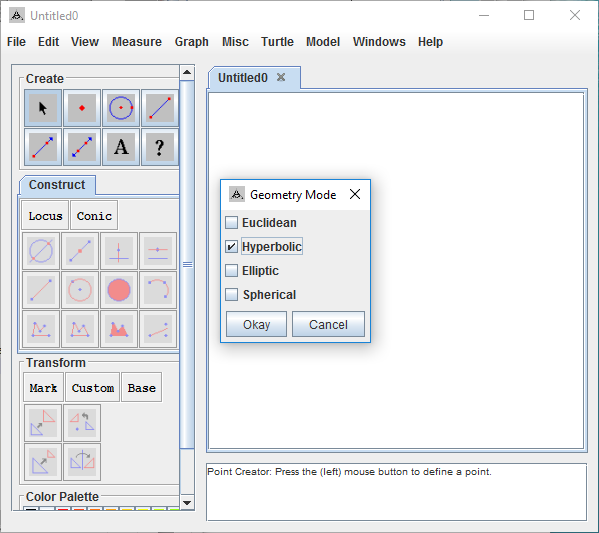
A new tab will open up with the Poincare model of Hyperbolic Geometry. Note that all of the tools and menus are still visible. All of the tools that do not depend on Euclidean parallels are still usable in this geometry.

Hyperbolic Segments
As an example, click on the Segment button and then click and drag
to create a hyperbolic segment. Note that this
segment does not look like a 'normal' Euclidean segment. That is because it is not Euclidean!

On page 45 of the text we discuss what happens to B as we move towards the circle. If this software model were ideal, the point B would never leave the interior of the circle. The points in this geometry are constrained to exist only inside the disk. We do see that the segment does not leave the disk, which is accurate. But, it also disappears! You will have to imagine that point B cannot leave the disk.

Hyperbolic Length
On page 45 we also discuss what happens to the length of a segment as it is moved around
in this hyperbolic geometry. Construct a segment AB near the center of screen. We can measure
the length of the segment by selecting the segment and then
choosing Length from the Measure menu.
The value of this measurement is the hyperbolic
distance from A to B. Next, select the segment and move it around the screen. The
length does not change!

Hyperbolic Circles
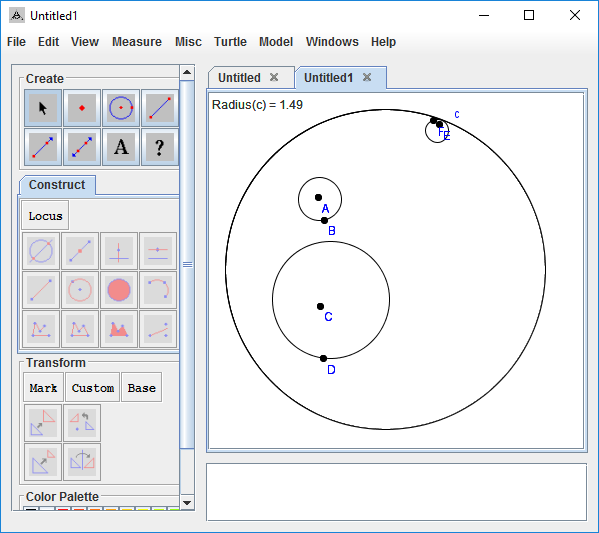
On page 46, we create circles in this geometry. Select one of these circles and measure its radius. (Choose
Radius from the Measure menu.)

Select the circle for which we measured the radius and drag it toward the boundary. The measured radius does not change, even though it looks like the circle shrinks to nothing as we approach the boundary.
Hyperbolic Angles
On page 47, we look at what happens to angles as we move them
via hyperbolic motions. Create a segment AB and then a segment BC from B.
Select A, B, and C (in that order) and choose
Angle from the Measure menu to measure the angle.

Now, select the three points A, B, and C in a group and drag them with the mouse, moving the angle around the screen. Movement of the angle has no effect on the angle measurement.

The remaining constructions and exercises in Project 2 should now be doable.